Explore how tortoise burrows create shelter, influence soil, and provide opportunities for other animals—and what this means for conservation.
Introduction
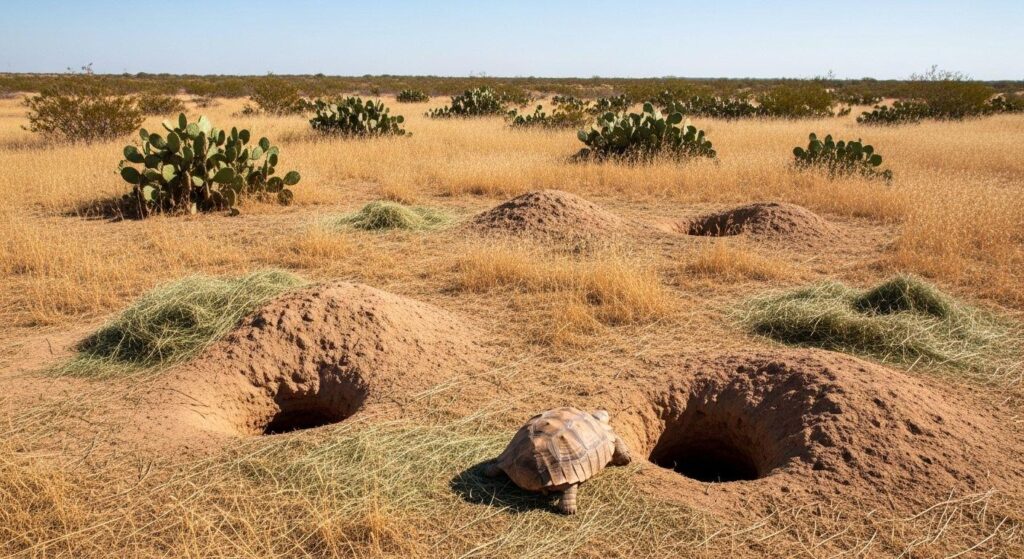
A tortoise burrow may look like a simple hole in the ground, but it can be an important part of a dryland ecosystem. For tortoises, underground shelters provide protection from extreme temperatures and help them survive challenging environmental conditions.
The ecological idea of an ecosystem engineer describes an organism that changes its surroundings in ways that influence other living things. Tortoises can fit this idea through their digging and use of shelters, although the strength of the evidence depends on the species and the ecosystem being studied.
For Sulcata tortoises, understanding burrows means looking at more than their ability to dig. It means considering how shelter, soil, vegetation, and wildlife interact.
1. What Is an Ecosystem Engineer?
An ecosystem engineer is an organism that modifies its physical environment, creating conditions that can affect other organisms.
Beavers are a well-known example because their dams change water flow and create wetland habitats. Tortoises can also influence their surroundings by digging burrows, moving soil, and creating or maintaining underground shelters.
However, not every animal that digs is automatically a major ecosystem engineer. The ecological importance of a burrow depends on how it changes the environment and whether other organisms benefit from that change.
2. Why Tortoises Need Burrows
Burrows are essential shelters for many tortoise species. They provide protection from extreme heat, cold, and changes in moisture.
Research on Agassiz’s desert tortoise in the Mojave Desert shows that burrows, dens, and rock shelters are important for escaping temperature extremes and limited moisture. [1]
For Sulcata tortoises, which are native to the dry regions of Africa, burrowing is also a natural behavior. Their ability to dig helps them seek shelter and manage the environmental challenges of their habitat.
A tortoise burrow is therefore more than a place to rest. It is part of the animal’s survival strategy.
3. How Burrows Can Influence Other Animals
One of the most interesting questions in tortoise ecology is whether burrows provide benefits to other species.
Underground shelters can create protected spaces that differ from the surrounding surface environment. In dry regions, these spaces may offer more favorable conditions than the exposed ground, especially during periods of extreme heat or cold.
Research on desert tortoise habitats has documented the importance of burrows and shelters to tortoise ecology. Scientists have also observed other species using tortoise burrows, including during studies of desert wildlife. [2]
This supports the idea that tortoise shelters can be relevant to broader ecological relationships. However, the exact benefits to other animals need to be studied carefully rather than assumed.
4. Soil, Vegetation, and the Burrowing Process
Digging changes the physical structure of soil. Tortoises may loosen or move soil as they create and maintain shelters.
Soil conditions are important to desert ecosystems because they influence water movement, plant growth, and the ability of vegetation to recover after disturbance.
USGS research on desert tortoise habitat restoration emphasizes the importance of soil, native vegetation, and habitat structure. The research also shows that restoring damaged desert environments requires attention to several connected factors rather than focusing on a single feature. [3]
This gives us an important conservation lesson: a burrow should be understood as part of a larger habitat system.
5. What Scientific Research Actually Shows
It is important to distinguish between established findings and ecological possibilities.
Research on Agassiz’s desert tortoise has demonstrated that burrows are important shelters and that tortoise burrows can be used by other species. Research also shows that protecting habitat and maintaining suitable vegetation can support healthier tortoise populations. [1][2][4]
However, these findings do not prove that Sulcata burrows have the same effects on every animal in the Sahel or other parts of Africa. More research is needed to measure how wild Sulcata burrows influence soil, plants, insects, reptiles, and other wildlife.
Careful conservation science asks not only whether a burrow exists, but also what changes it creates and which organisms actually benefit.
6. What This Means for Restoration
Understanding tortoise burrows can help conservationists think about habitat as a connected system.
Restoration practitioners working in dryland environments may consider soil condition, vegetation, shelter, and human disturbance together. Research on desert tortoise habitat restoration has found that protecting vegetation and improving soil conditions can contribute to habitat recovery. [3]
For Sulcata conservation, this suggests that protecting natural landscapes is important. Maintaining native vegetation, reducing habitat degradation, and supporting research into wild tortoise ecology can help preserve the conditions these animals depend on.
Conservation should focus on natural ecosystems rather than simply creating artificial burrows without understanding the surrounding habitat.
7. An Expert Perspective
Dr. Kristin Berry, a research wildlife biologist with the U.S. Geological Survey, has studied desert tortoise ecology for decades. Her research describes burrows, dens, and rock shelters as important features that help tortoises escape extreme temperatures and limited moisture. [1]
Her work provides a useful scientific foundation for understanding why tortoise shelters matter. It also reminds us that habitat conservation must consider the physical environment and the behavior of the animals that depend on it.
While this article draws on published research and an expert’s documented findings, it does not include a new interview with Dr. Berry. A future article could explore this topic further through an interview with a qualified herpetologist or restoration practitioner working directly with Sulcata tortoises.
Conclusion
Tortoise burrows are a fascinating example of how animals interact with their environment. They provide shelter for tortoises, influence the physical landscape, and may create opportunities for other species.
For Sulcata tortoises, understanding burrows means understanding the relationship between animal behavior and habitat. The more we learn about these connections, the better we can support responsible ownership, habitat protection, and conservation.
At Operation: Slow Crawl, we believe that every tortoise has an important role in the natural world. Protecting that world begins with education, careful research, and respect for the ecosystems that sustain life.